Google Review Policy and Rules 2026 Update
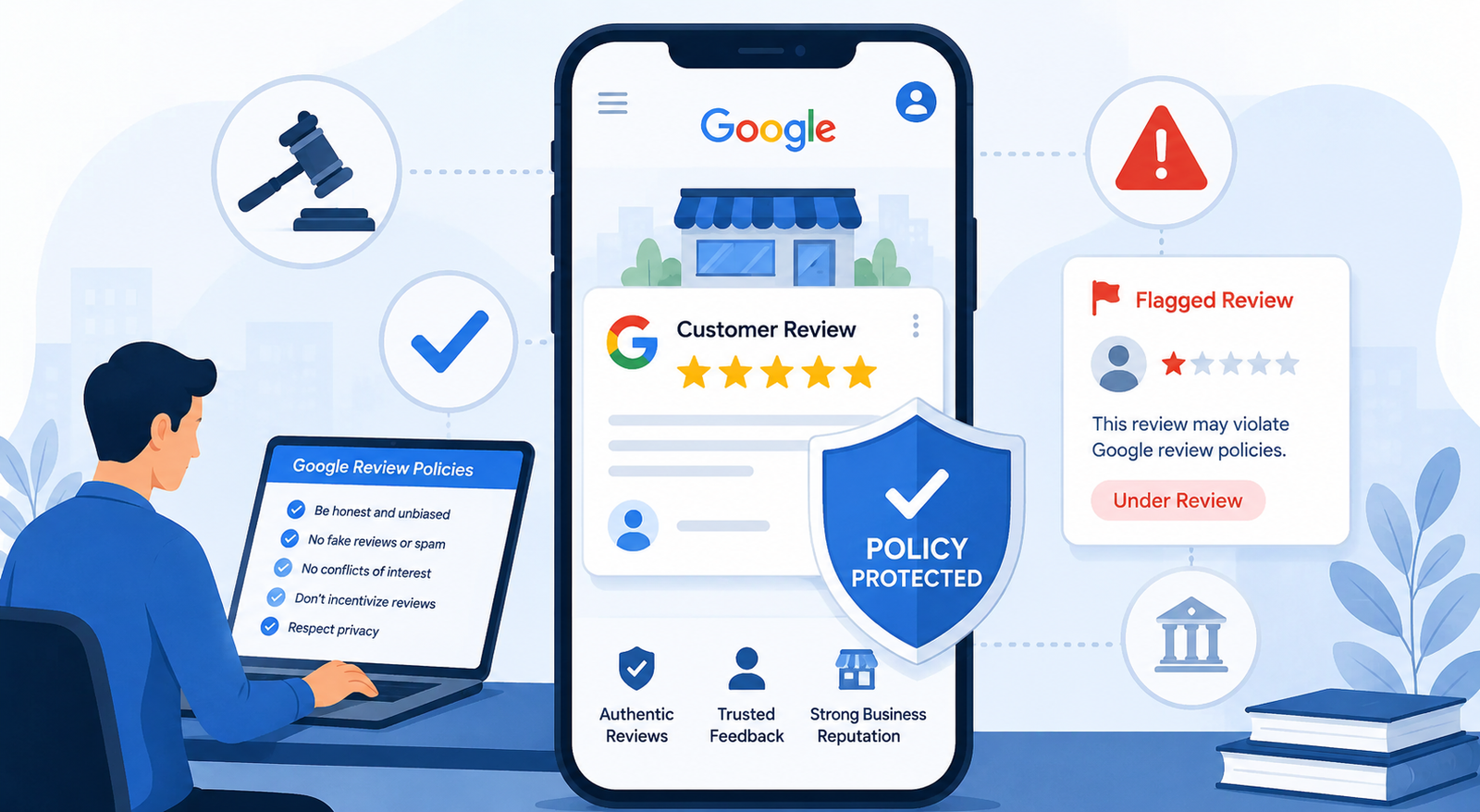
Google reviews shape whether a customer picks up the phone or scrolls past your business. That influence is exactly why Google keeps tightening the rules around what counts as a genuine review and what counts as manipulation.
In 2026, Google made some of the most significant changes to its review policy in years. Practices that businesses treated as normal for over a decade are now formal violations. Reviews are being removed at a scale that surprises a lot of business owners.
This guide breaks down the full Google review policy for 2026 in plain language. You will learn what is banned, what is still allowed, how enforcement works, and what to do if your reviews get pulled.
Key Takeaways
- Google updated its Prohibited and Restricted Content policy for Maps user generated content in early 2026, adding explicit new bans on staff review quotas and requests for specific review content.
- Incentivized reviews, review gating, and on premises pressure to leave a review remain strictly prohibited and are now being enforced far more aggressively.
- Google’s automated systems, powered by its Gemini models, actively scan for fake, coached, and AI generated review text.
- Businesses can still ask customers for honest feedback. What they cannot do is script the wording, target only happy customers, or offer any reward.
- Violations can lead to removed reviews, restricted profile features, or a suspended Google Business Profile.
- Understanding how a reviewer’s account history and activity level affects credibility connects directly to this topic. If you want the background on that, our earlier guide explains how Google review points and levels work.
What Is the Google Review Policy?
The Google review policy is the official rulebook that governs what people can post on Google Business Profiles and how Google Maps handles that content. It sits inside Google’s broader Maps user generated content policy and covers everything from fake reviews to hate speech to advertising in review text.
The purpose of the policy has never changed. Google wants reviews to reflect a real, unbiased experience with a business. What has changed over the last two years is how specific Google is about what breaks that standard, and how quickly its systems catch violations.
Why Google Updated Its Review Policy in 2026
Fake and manipulated reviews have become a large scale problem. In its 2025 Trust and Safety Report, Google said it blocked or removed more than 292 million policy violating reviews in a single year. A meaningful share of that volume came from AI generated review text, which became cheap and easy to produce once large language models went mainstream.
Google responded by rewriting parts of its Prohibited and Restricted Content guidelines and by deploying Gemini powered detection across Maps and Search. The result is a review environment where practices that used to slide under the radar now get flagged within days.
What Changed in the 2026 Google Review Policy Update
Two dates matter most for this update.
The February 2026 Language Refresh
In February 2026, Google sharpened the wording around on premises review requests. The updated language made clear that merchants should not require or pressure customers to leave a rating while they are still physically at the business, and should not request that specific content be included in the review.
The April 2026 Rating Manipulation Update
On April 16, 2026, Google published its 2025 Trust and Safety Report alongside new Maps protections. The very next day, April 17, Google quietly added two new clauses to the Rating Manipulation section of its Maps user generated content policy.
Those two new clauses prohibit merchants from doing the following.
- Requesting that staff solicit a specific number of reviews, commonly known as a review quota.
- Requesting that staff solicit reviews that include specific content, including content that identifies a staff member by name.
Neither of these clauses reversed anything Google previously allowed. They closed loopholes that agencies and business owners had been relying on for years, such as encouraging customers to mention a technician or salesperson by name in their review.
Full List of Prohibited Review Practices
The current policy groups violations into several categories. Here is a complete breakdown based on Google’s official Maps user generated content guidelines.
Fake Engagement
Google removes any content that is not based on a real experience or that does not accurately represent the business or location. This category also includes content posted from multiple accounts by the same person, and content generated using an emulator or modified device meant to fake genuine activity.
Rating Manipulation and Incentivized Reviews
This is the category most business owners run into without realizing it. Prohibited actions include the following.
- Offering payment, discounts, free goods, or free services in exchange for posting, revising, or removing a review.
- Discouraging negative reviews or selectively asking only satisfied customers for feedback, a practice known as review gating.
- Requiring or pressuring a customer to leave a review while they are still on the premises.
- Directing staff to hit a review quota.
- Directing staff to request that a review mention a specific employee or contain specific wording.
- Posting content on a competitor’s profile to damage their reputation.
- Basing a review on a conflict of interest, such as current or former employment, a consulting relationship, or a family connection to the business.
Impersonation
Content that pretends to come from another person, group, or organization is not allowed. This includes posing as a verified authoritative source.
Misinformation and Misrepresentation
Google prohibits deceptive health information, misleading claims about civic processes, and manipulated content about newsworthy events. It also bans distorted or omitted facts intended to scam users or unfairly influence their decisions.
Harassment and Hate Speech
Reviews cannot contain threats, doxxing, or unwanted sexualization of a person. Content that dehumanizes or attacks someone based on a protected characteristic such as race, religion, disability, age, nationality, or gender identity is strictly banned.
Offensive Content
This covers deliberate provocation and unsubstantiated accusations of criminal or unethical behavior. Google does still allow customers to describe a negative experience, as long as it is done respectfully and reflects something that actually happened.
Sexually Explicit and Adult Themed Content
Pornographic material, nude imagery, and content that sexualizes objects or people are removed. Google may allow adult themed content in limited educational or documentary contexts.
Violence and Gore
Shocking or gratuitous violent imagery involving people or animals is prohibited, along with any content depicting animal cruelty.
Personal Information
Reviewers cannot post another person’s full name, face, financial data, or medical information without consent. There is an exception for public facing professionals, such as doctors, lawyers, real estate agents, and executives whose names are already tied to the business publicly.
Off Topic Content and Advertising
Reviews need to be about an actual experience at the location. General political commentary, personal rants unrelated to the business, and promotional content including phone numbers or links are not permitted.
Restricted Content Categories
Some legal products and services carry extra restrictions even when the underlying business is legitimate. This includes alcohol, tobacco, gambling, firearms, regulated pharmaceuticals, and financial services. Reviews cannot include purchase links, contact details for buying restricted goods, or promotional pricing for those categories.
Comparison Table Old Rules vs New 2026 Rules
| Practice | Before 2026 | 2026 Policy Status |
|---|---|---|
| Asking every customer for honest feedback | Allowed | Still allowed |
| Offering a discount for a review | Prohibited | Still prohibited, enforcement stronger |
| Review kiosk or shared tablet in store | Gray area, loosely enforced | Explicitly prohibited |
| Asking a customer to mention an employee by name | Common practice | Explicitly prohibited |
| Setting a weekly review quota for staff | Common practice | Explicitly prohibited |
| Review gating by sentiment | Prohibited | Still prohibited, enforcement stronger |
| AI generated review text | Not addressed | Actively detected and removed |
| Sending a review link after service, open ended | Allowed | Still allowed and encouraged |
Step by Step Guide to Building a Compliant Review Collection Process
- Write one open ended message. Keep the ask simple, something like a request to share honest feedback about the visit, without naming a staff member or suggesting specific wording.
- Send it to every customer equally. Do not filter by sentiment before sending. Every customer who completes a transaction should get the same invitation.
- Time it after the visit. Send the request by text or email once the customer has left the location, never while they are still on site.
- Remove incentives entirely. No discounts, no loyalty points, no giveaway entries tied to leaving a review.
- Audit existing scripts. Rewrite any staff training material that references quotas, specific phrasing, or employee name mentions.
- Monitor review volume patterns. Sudden spikes from the same time window or geographic cluster can trigger Google’s fraud detection even when the reviews are genuine, so spread out collection naturally.
- Respond to every review professionally. A calm, factual response protects your reputation for future readers regardless of whether a review gets removed.
Common Mistakes Businesses Make
- Assuming the April 2026 update only applies to home services and auto repair, when it actually applies to every business category on Google Maps.
- Continuing to use pre-written review templates that ask customers to mention a specific product or team member.
- Believing that a genuine experience protects a review even if it was solicited through a prohibited method like an incentive.
- Ignoring third party review software that quietly performs sentiment based gating on the business’s behalf.
- Ignoring reviewer credibility signals. A profile with a long history of varied contributions carries more weight, and understanding how Google review points and levels work can help you see why some reviews get more scrutiny than others.
Expert Tips for Staying Compliant
- Keep your review request language identical for every customer so there is no appearance of selective solicitation.
- Train front desk and field staff that the review ask should happen once, briefly, and never in front of the customer at checkout.
- Treat your Google Business Profile like a compliance sensitive asset. Review your solicitation process every time Google announces a policy change.
- Avoid third party growth agencies that promise a guaranteed number of new reviews per month. That structure often violates the quota prohibition even if the agency does not disclose it.
- Focus on the actual customer experience. The most durable way to earn strong reviews is still to deliver a service worth talking about.
How Google Enforces the Review Policy
Google’s enforcement runs on a mix of automated detection and human review. Gemini powered classifiers scan review text for patterns associated with manipulation, including coached phrasing, employee name mentions that appear too frequently, and language patterns typical of AI generated writing.
The system also looks at account level signals, such as how new the reviewer’s account is, how many other contributions it has made, and whether several reviews were posted from the same device or IP range within a short window.
When the system flags a violation, the review can be removed automatically, or the business profile can be flagged for a manual investigation. Repeated violations can lead to feature restrictions or, in severe cases, suspension of the Google Business Profile itself.
What Happens When You Violate the Policy
Consequences scale with the severity and frequency of the violation.
- First time or isolated issue. A single flagged review is typically removed, with no further action against the profile.
- Pattern of violations. Google may restrict specific profile features, such as the ability to respond to reviews or add photos.
- Severe or repeated violations. The entire Google Business Profile can be suspended, removing the listing from Maps and Search results entirely.
Reviews collected through a now prohibited method, such as an incentivized campaign, can be removed even if they were posted before the 2026 update took effect. Google’s enforcement applies retroactively when a clear policy violation is identified.
If you are dealing with reviews that seem to violate policy and are not sure which ones actually qualify for removal, it helps to understand the distinction between reviews you dislike and reviews that break a rule. Our next guide covers exactly which Google reviews can actually be removed and which ones you will need to respond to instead.
How to Report a Review That Violates Policy
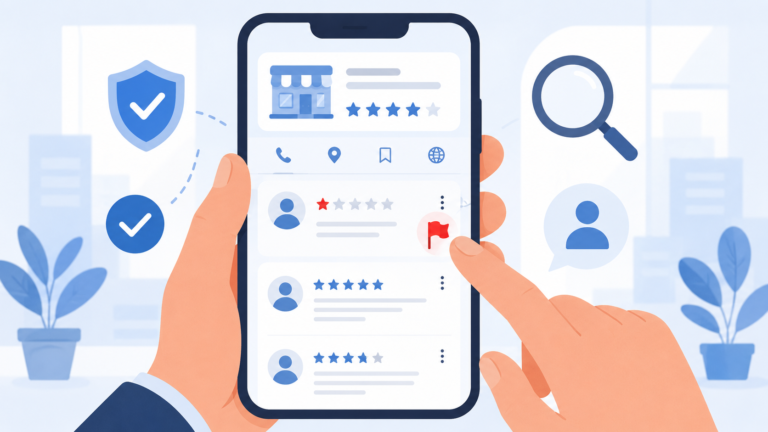
- Open your Google Business Profile and locate the review in question.
- Select the flag or report option next to the review.
- Choose the specific policy category it violates, such as conflict of interest, fake engagement, or off topic content.
- Submit the report. Reporting is anonymous to the reviewer.
- Monitor your profile for a response, which can take anywhere from a few days to several weeks depending on volume.
- If the review is not removed and you believe the decision was wrong, use Google’s appeal process for user generated content enforcement actions.
Because these reviews are evaluated case by case and removal is never guaranteed, many businesses choose to bring in a specialized Google review removal company to handle documentation, policy citations, and the appeal process professionally.
Best Practices for a Google Review Policy That Keeps Changing
- Check the official Maps user generated content policy page periodically, since Google updates it without always issuing a public announcement.
- Build review collection into your natural customer communication flow instead of treating it as a separate campaign.
- Keep a written record of your review request process in case you ever need to demonstrate compliance during an appeal.
- Educate every employee who interacts with customers, not just marketing staff, since front line requests are the most common source of violations.
- Prioritize response quality over review volume. A smaller number of authentic, detailed reviews builds more trust than a large batch of near identical five star ratings.
Conclusion
Google’s 2026 review policy update did not change the philosophy behind the rules. Reviews still need to reflect a genuine, unbiased experience. What changed is the level of detail in the policy language and the aggressiveness of enforcement behind it.
Businesses that keep their review requests simple, open ended, and free of incentives will come through this update fine. The ones at risk are the businesses still running quotas, kiosks, or scripted requests that name staff members, because those practices are now explicitly against the rules and actively detected.
Frequently Asked Questions
What is the Google review policy in simple terms?
It is the set of rules that determine what content is allowed in reviews and ratings on Google Maps and Google Business Profiles, built around the requirement that every review reflect a genuine, unbiased customer experience.
When did Google last update its review policy?
Google made its most significant recent changes in early 2026, with a language refresh in February and two new prohibitions added to the Rating Manipulation policy on April 17, 2026.
Can I still ask customers to leave a Google review?
Yes. You can send an open ended, reward free request to every customer equally, timed after the visit rather than while they are still on site.
Is it against policy to offer a discount for a review?
Yes. Offering any payment, discount, free good, or free service in exchange for posting, editing, or removing a review has always been prohibited, and enforcement has increased significantly.
Can I ask a customer to mention a specific employee in their review?
No. As of the April 2026 update, directing staff to request reviews that name a specific employee or include specific wording is an explicit policy violation.
Does Google remove AI generated reviews?
Yes. Google’s Gemini powered detection systems actively identify review text that shows patterns typical of AI generated writing and remove it, even if the underlying experience described was real.
What happens if my business violates the review policy repeatedly?
Repeated violations can lead to restricted profile features, such as the loss of the ability to respond to reviews, and in severe cases can result in full suspension of the Google Business Profile.
Can old reviews be removed under the new policy?
Yes. Reviews collected through a method that is now prohibited, such as an incentivized campaign, can be removed retroactively even if they were posted before the update.
How do I report a review that breaks Google’s policy?
Flag the review directly from your Google Business Profile, select the specific policy category it violates, and submit the report. Reviews are evaluated against the guidelines before any removal decision is made.
Is review gating still against the rules?
Yes. Filtering customers by sentiment before sending a review request, commonly called review gating, has always been prohibited and remains one of the most actively enforced violations in 2026.